
ADVERTISEMENT
ADVERTISEMENT
ADVERTISEMENT
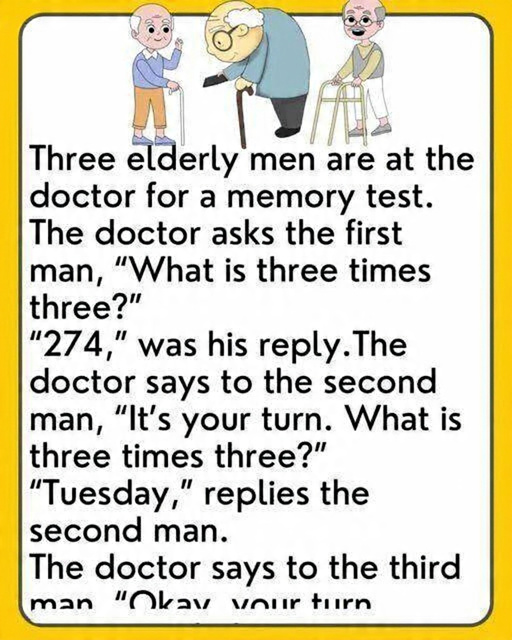
Three elderly men made their slow, careful way into a doctor’s office for what was meant to be a routine memory check. They carried themselves with the easy humor of people who had lived long enough to know that laughter often mattered more than answers. Clipboard in hand, the doctor explained he would ask a few simple questions. The men exchanged glances, already suspicious of the word simple.
The doctor started with the first man.
“What is three times three?”
The man sat up straight and answered confidently, “Two hundred seventy-four.”
The doctor paused, wrote something on his chart, and wondered how the man’s mind had arrived there.
The same question went to the second man. Without a second’s thought, he replied, “Tuesday.”
He sounded absolutely certain. A nurse watching nearby pressed her lips together to keep from laughing. The doctor nodded politely and moved on.
Finally, the third man was asked. He hesitated, then said, “Nine.”
Relief washed over the doctor—until the man grinned and added, “Because I borrowed your calculator when you weren’t looking.”
The room erupted in laughter. The nurse laughed, the men laughed, and even the doctor smiled. In that moment, he realized something important: these men weren’t losing who they were. Their humor, creativity, and spark were still alive and well.
The doctor closed his chart and pulled up a chair.
“Tell me about your younger days,” he said.
The tone in the room instantly changed. The first man spoke about building radios from scraps, chasing distant signals late into the night. The second shared stories of hitchhiking across towns, making friends wherever he landed. The third talked about decades spent repairing clocks, convinced time itself had a personality—sometimes patient, sometimes stubborn, but always moving forward.
The doctor listened, captivated. These weren’t fading memories—they were rich, detailed, and full of meaning. The nurse stepped closer, drawn in by the warmth of their stories.
By the end of the visit, the doctor had abandoned the idea of scores and charts. What mattered was connection. He scheduled another appointment—not for testing, but for conversation.
A week later, he introduced a weekly “Memory Circle” at the clinic. Seniors gathered not to be evaluated, but to talk, laugh, and share their lives. At first, only a few showed up. Soon, the room buzzed with laughter and storytelling.
The three men came every week. One entertained the group with radio mishaps, another became the natural storyteller, and the third brought a pocket watch—a quiet reminder that time keeps moving.
Some days they forgot names. Some days they repeated the same stories. No one minded. The purpose wasn’t perfection—it was presence.
Over time, the doctor noticed a change. The men laughed more, stood a little taller, and seemed sharper. He realized memory wasn’t just stored in the mind—it lived in shared moments, community, and being truly seen.
Months later, he often thought back to that first visit—the impossible math answers, the sneaky calculator joke, the laughter that changed everything. What began as a simple test had grown into something meaningful.
The men still attend the Memory Circle. Sometimes their answers are wildly wrong. Sometimes they’re spot on. But they always leave smiling.
Their value was never in test results. It lived in laughter filling the room, in stories shared between friends, and in the dignity of being known. Aging, they discovered, wasn’t about what fades—it was about holding on to humor, warmth, and connection.
And now and then, when the doctor passes them in the hallway, the third man taps the calculator in his pocket and offers a playful wink.
ADVERTISEMENT